Phitsanulok Mansion

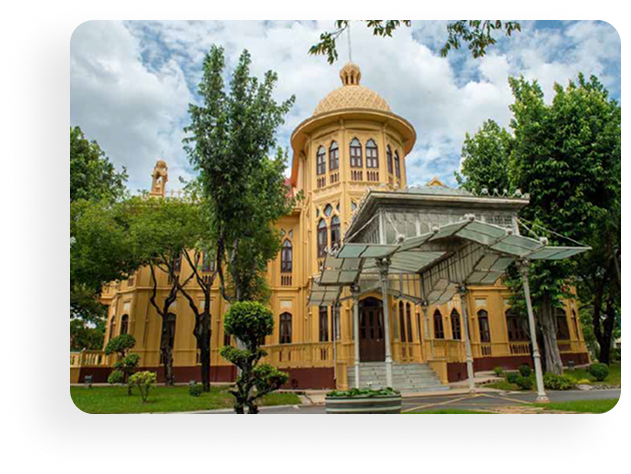
Phitsanulok Mansion, formerly known as Ban Banthomsin, is located on Phitsanulok Road in Dusit District. It was commissioned by King Vajiravudh (Rama VI), who personally financed its construction as a royal gift to Major General Phraya Anirut Deva (Mom Luang Fuen Phuengbun). The mansion stands on a 50-rai estate (approximately 22.5 acres), adjacent to the Royal Horse Guards, the original site of the Royal Turf Club of Thailand under Royal Patronage—an area the King often used as a private retreat for relaxation and sporting activities.
Major General Phraya Anirut Deva began his royal service as a page of the Royal Chambers. He was later appointed Nai Sunthorn Manomai (a Royal Page of the Hum Phrae class), Master of the Horse of the Assavaraj Division (the Royal Cavalry Escort), and subsequently promoted to Luang Sakdinaiwen (Master of the King's Household), becoming Chao Muen Si Sornrak, Chief of the Royal Bedchamber. He then rose to the rank of Changwang Ek.
Phraya Anirut Deva served as Director-General of the Royal Pages Department and as Director of the Department of Royal Entertainment (now the Fine Arts Department). He later became a Major General, Commander of the Palace Guards, and Deputy Commander of the Royal Guards under King Rama VI. He was invested with the rank of Maha Sewak Ek, equivalent to the position of Maha Amat Ek at that time.
Construction of Phitsanulok Mansion began in 1922 under the design of an Italian architect who had previously completed the project of the Ananta Samakhom Throne Hall. The mansion therefore reflects Italian Baroque architectural style. A large pond was excavated to obtain soil for raising the foundation of the main building, and stones from Ratchaburi and Saraburi were brought in for the base structure. A smaller residence for Phraya Anirut Deva and his family was also built as temporary living quarters during construction. In addition to the main building, several additional structures were also constructed over time, with the entire project reaching completion in 1925.
Additional Structures in Phitsanulok Mansion
Tuek Yai (Main Building)
Construction of the Tuek Yai began in 1923 in the Venetian Gothic Revival style. This three-storey structure includes a basement. The ground floor features a grand sitting hall and two reception rooms. Behind the reception rooms is a butler’s pantry used for serving meals and beverages to guests. The second floor contains bedrooms on both wings, while the third floor houses a large prayer hall beneath the central dome. Behind the prayer room is another bedroom that opens onto a rooftop terrace with panoramic views. The residence is designed with high ceilings for ventilation, and the ceilings are adorned with exquisite fresco paintings. A chandelier with multicolored crystal ornaments hangs at the center. Both interior and exterior walls are decorated with ornate stucco and carved woodwork. The spiral staircase is a notable architectural feature, constructed without a single supporting column. The government later renamed the Main Building as Thai Phanthamit Building, using it as the official residence of the Prime Minister and for receiving visiting dignitaries.
Yaojai Pavilion
A two-storey building located behind the Main Building, connected to it on both floors by wide passageways, giving the impression of a unified structure. In front of the pavilion is a small pond with Victoria water lilies and a sculpture of three Roman maidens at its center. Yaojai Pavilion was originally used for rehearsals of royal plays by the Banthomsin theatrical troupe. The government now uses it as accommodation for entourages of visiting dignitaries and as an additional workspace for the Prime Minister’s staff.
Khu Jai Pavilion
A private reception residence for the Prime Minister, this wooden house features a large veranda by the pond. It is distinguished by paneled wooden walls and horizontally laid wooden planks typical of traditional Thai wooden homes.
Klampakorn House
Formerly the living quarters of housekeepers and cooks who served the entire Banthomsin estate, this building is now used as housing for gardening and nursery staff. It is a wooden structure, emphasizing paneled woodwork and horizontally aligned wooden planks similar to traditional wooden houses.
Than Kamnan Hall
A single-storey building resembling a large hall, decorated with elaborate ceiling paintings. King Vajiravudh used this hall privately for changing attire before observing or participating in sports such as tennis with courtiers and foreigners. He particularly enjoyed playing English-style polo. The government currently uses the hall for seminars, major receptions, and important political functions, such as welcoming visiting delegations.
Sopha Pavilion
A wooden structure with paneled woodwork, used as a workspace and rest area for security personnel. Surrounding the residence are landscaped lawns and European-style gardens. At the rear lies a large pond with water lilies and various species of fish. The front gable features the statue of Narai Banthomsin, the royal emblem bestowed upon the family, displayed on a stone pedestal within a fountain.
In 1942, during the premiership of Field Marshal Plaek Phibunsongkhram, the Crown Property Bureau purchased half of the estate to serve as a government guesthouse, which Phraya Anirutthathewa sold to the state. The government used the site for the Thai–Japanese Coordination Department, renamed the Main Building as Thai Phanthamit Building, and changed the estate’s name from Ban Banthomsin to Phitsanulok Residence after the name of the road. After World War II, Phraya Anirutthathewa sold the remaining half of the land to Mission Hospital.
In 2003, major renovations were undertaken for the APEC Leaders’ Meeting, including repainting the entire complex, refurbishing the interiors of Thai Phanthamit Building, improving bathrooms, installing air-conditioning in Than Kamnan Hall, and enhancing the surrounding landscape.
Nowadays, Phitsanulok Residence is under the supervision of the Office of the Secretary-General to the Prime Minister. It covers a total area of 23 rai, 2 ngan, and 10 square wah, and has undergone multiple restoration efforts under various governments to preserve its architecture and registered sculptures, ensuring their beauty and historical value for long-term conservation.