Manangkhasila Mansion

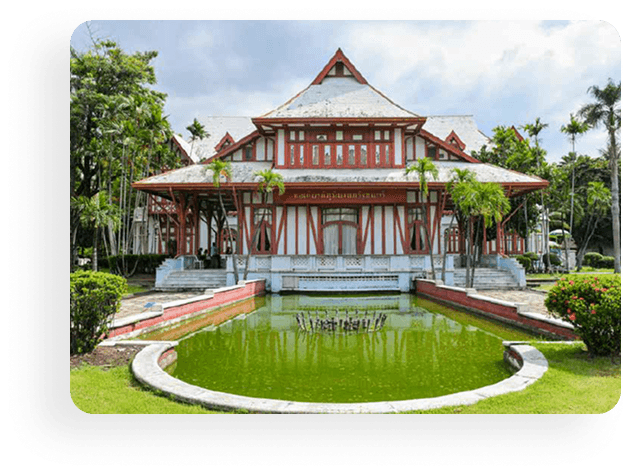
This historic mansion is located on Lan Luang Road in Saphan Khao sub-district, Dusit district. The property of approximately 12 acres, or 30 rai, was a gift of King Vajiravudh (King Rama VI) presented to Phraya Udom Ratchaphakdi (Tho Sucharitkul). The king also financed the design and construction of the residence, which he named Manangkhasila Mansion. Unfortunately, the king passed away before the completion of the mansion and thus never saw the finished villa.
Designed by the English architect Edward Healey, who at the time served as an engineer under the Ministry of Education, Manangkhasila Mansion was built in the Tudor style popular in 16th-century England, featuring stucco walls with exposed wooden frames and intricate half-timbered detailing.
Manangkhasila Mansion holds significant historical and cultural value. It once served as the residence of royal courtiers and members of the royal family during the reign of King Vajiravudh (Rama VI) and Queen Indrasakdi Sachi, his Royal Consort. In 1952, ownership of the property was transferred to the Asia Bank. The government later borrowed the mansion for use as a state guesthouse under the supervision of the Office of the Prime Minister and as a meeting venue for pro-government members of Parliament.
In 1955, during the administration of Field Marshal Plaek Phibunsongkhram, the mansion was used as the headquarters of the ruling Seri Manangkhasila Party. However, following the coup d’état in 1957, which led to the dissolution of the party, the Asia Bank requested to reclaim ownership of the property for maintenance. However, as the government retained shares in the bank, the mansion continued to be used occasionally to host visiting guests.
In 1960, the Ministry of Finance expressed its intention to reclaim the site of the Bank of Thailand at Bangkhunphrom. Consequently, the Bank of Thailand purchased Manangkhasila Mansion from the Ministry of Finance to serve as one of its offices. The mansion thus became state property under the Treasury Department’s supervision from that year onward.
Subsequently, the government received the mansion for use as an official guesthouse under the care of the Office of the Prime Minister, a role it continues to serve today. Later, on October 22, 1975, the National Council of Women of Thailand under the Royal Patronage was granted permission to use Manangkhasila Mansion as its headquarters, a function that remains to the present day.
Architectural Features
Manangkhasila Mansion today comprises a complex of eight main buildings along with several additional structures, as follows:
Preserved Buildings
All eight of the following buildings were designated as national historical landmarks เพิ่ม by the Fine Arts Department in 1985:
- The Reception Building is a two-story structure connected to the main building on the upper floor, while the lower level is separated by a roadway that forms part of a circular drive leading to the entrance. The ground floor features verandas at the front and on both sides of the building, with marble flooring throughout. Five-step stairways provide access at both the front and rear. The front façade is decorated with a reflecting pool and two European-style bronze sculptures.
- The Main Building, or Principal Building, is a large two-story brick-and-stucco structure connected to the Reception Building. Rectangular in shape on both levels, the building is fully enclosed and constructed in the Tudor architectural style, characterized by its color scheme, decorative wall patterns, and distinctive half-timbered wooden framework. The upper floor extends outward, supported by exposed beams known as a “jetty.” The design harmoniously blends Western architectural features with the Thai environment, technology, lifestyle, and cultural limitations, resulting in a unique architectural identity. Manangkhasila Mansion became a model of luxury residences popular among the affluent of its time, admired for its grandeur, spaciousness, and exquisite elegance.
- The National Council of Women of Thailand Building 1 is located to the right of Manangkhasila Mansion. This two-story European-style structure features marble stairs leading to the main entrance. Inside, the lower floor contains three rooms and the upper floor two rooms. It currently serves as the executive office and meeting facility.
- The Handicraft Training Center is a small two-story building also used by the National Council of Women of Thailand. The lower floor serves as a training area for women’s community groups, while the upper floor functions as the office library.
Other Buildings
Additional buildings situated toward the rear of the compound include:
The Manangkhasila Meeting Hall, located behind the main building.
The National Council of Women of Thailand Building 2, a small two-story structure located behind Building 1.
The Relief Foundation Office, a two-story building situated to the left of the main mansion, designed in the same style as the second National Council of Women’s building.
The Row House, a two-story wooden building currently serving as residential quarters for staff members under the Office of the Prime Minister’s Secretariat.
The craftsmanship displayed in the construction of Manangkhasila Mansion is regarded as remarkable and distinctive, showcasing a harmonious blend of European and Thai architectural styles. In recognition of its historical and architectural significance, the mansion was conferred the Architectural Conservation Award by the Association of Siamese Architects under Royal Patronage in 2002.